

Corten steel is a material that often provokes a strong reaction when I use it in a landscape. Clients either love it or hate it. It is overlooked by some who see it as a trendy industrial style gimmick.
I view it differently and find it to be a perfect fit for sustainable landscapes. Rather than a trendy gimmick, it offers far a lot to a modern sustainable landscape. Corten steel is a balance between the organic and the architectural.
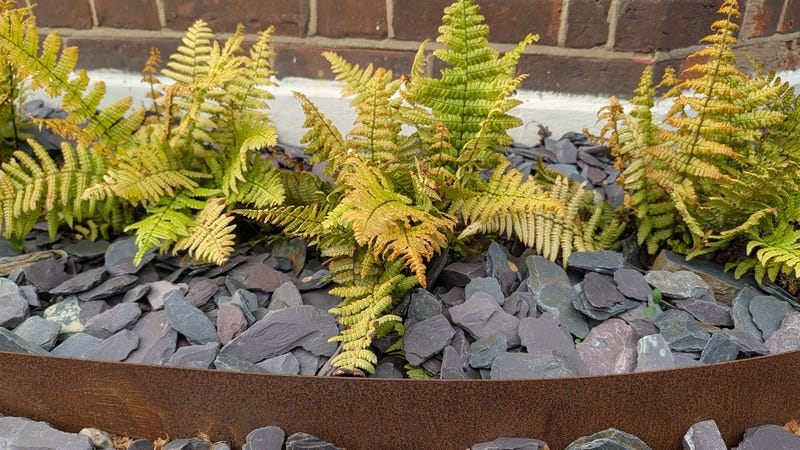
When people first see the deep, burnt-orange hue of corten steel, the immediate word that comes to mind is “rust.” In a garden setting, rust is traditionally seen as a sign of neglect. Rust is a precursor to decay and can turn metal into a safety hazard. Corten is a master of deception. Corten uses the appearance of age to protect itself from the elements, offering a permanence that few other metals can match.

Origin
Corten steel, or “weathering steel,” began its life not in the garden, but in the gritty industrial landscape of the 1930s. Corten was originally developed by United States Steel to build durable railroad coal wagons. The material was engineered to solve a specific problem for prevent structural decay without the constant need for protective paint.

The name itself is a functional hybrid, standing for CORrosion resistance and TENsile strength. Corten is a steel alloy, mixed with copper, phosphorus, and chromium. This mixture of elements creates a metal that uses its own oxidation as a structural shield. Oxidation is a fancy name for rust. When metal like steel is exposed to damp air it can rust and flake away into dust. Rather than flaking away like standard mild steel, the surface of corten develops a patina that seals the metal itself.
This patination is essentially turning rust into a permanent, maintenance-free finish that is very hardy. Corten is a common sight in the remote areas of the Western states in America. When I lived in California, it was available as roofing material and architectural siding as well as a material for landscaping. Remnants of these large panels began to see use as material for planters, edging and fencing which is where I learnt to use it. I used it a lot, and I really like it. I like it so much, it has become a bit of a hallmark for my landscape designs.
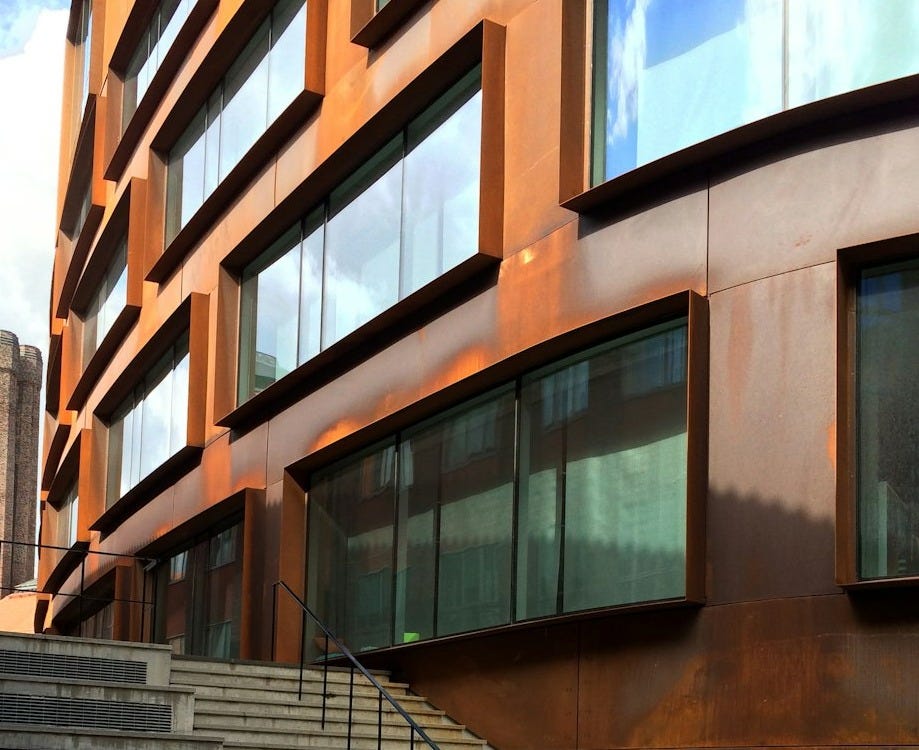
The Science of the “Living Skin”
To understand why Corten is a superior choice for a garden, one must first understand the difference between common rust and a stable patina. When standard carbon steel is exposed to moisture, it undergoes a process of oxidation that is destructive. The rust flakes away, exposing fresh metal, which then rusts again. This cycle continues until the material is structurally compromised.
Corten, or weathering steel, is alloyed with specific elements—copper, chromium, and nickel—that fundamentally change how it reacts to the atmosphere. When exposed to the cycle of wet and dry weather, it develops a dense, tenacious oxide layer. This “living skin” acts as a barrier, sealing the inner steel from further oxygen and moisture.
In the humid, often damp winters we experience in the South East, this process is particularly interesting. While the wet weather of a Surrey Winter might seem like an enemy to landscape materials like wood and metal, it is actually the catalyst for the steel’s protection. The patina will darken and deepen over several wet seasons, shifting from a bright sandy-orange to a rich bronze-chocolate. This isn’t decay, it is the steel maturing in a similar way that the plants in your landscape mature over time. For me, this makes it a more natural material. Unlike wood that will decay or be consumed by funghi and insects, it does not have a limited shelf-life.
Addressing the Safety Myth: Rust vs. Integrity
One of the most common objections I hear during the design phase is the fear that Corten will eventually become rusty and hazardous. People can imagine a lawn edge or a planter wall thinning out until it becomes a rough surface that could injure a child or a pet.

It is important to clarify that Corten does not flake or delaminate like mild steel. Because the patina is a part of the metal’s surface rather than a coating sitting on top of it, the structural integrity remains intact for decades. While standard steel might have a lifespan of a few years in direct contact with damp soil, corten steel is designed to last 50 years or more. It is a set it and forget it material that actually improves with age, requiring no painting, no sealing, and little maintenance.
From Subtle Edges to Structural Statements
In many of my projects, I have used Corten primarily as a tool for defining edges. the rustic colour is often very neutral to the colours found in a garden, but also provides a contrast. This subtle contrast helps define edges to separate a landscape into different areas. There is a certain elegance in using a thin, 100mm strip of corten to create a clean line between a lush green lawn and a gravel pathway.
For edging, I’ve found that specialized products like the Core Edge Corten Premium Lawn Edging are invaluable. Corten edging can create a well defined edge that traditional timber or plastic edging can’t match. Corten edging is flexible enough to follow the organic curves of a garden bed but rigid enough to maintain a perfectly straight line. Corten edges provide that architectural snap that defines a well-designed space. Corten steel is strong and can easily be spiked into the ground with high edges. The depth is very effective in Surrey gardens where we often deal with slight variances in soil levels. The higher edge provides enough face to be visible and attractive without being overbearing.
However, the true potential of Corten lies in moving beyond the ground level. There has been a shift toward using it as a structural solution for more than lawn or path edging.
Terracing and Slopes: The Industrial Retaining Wall
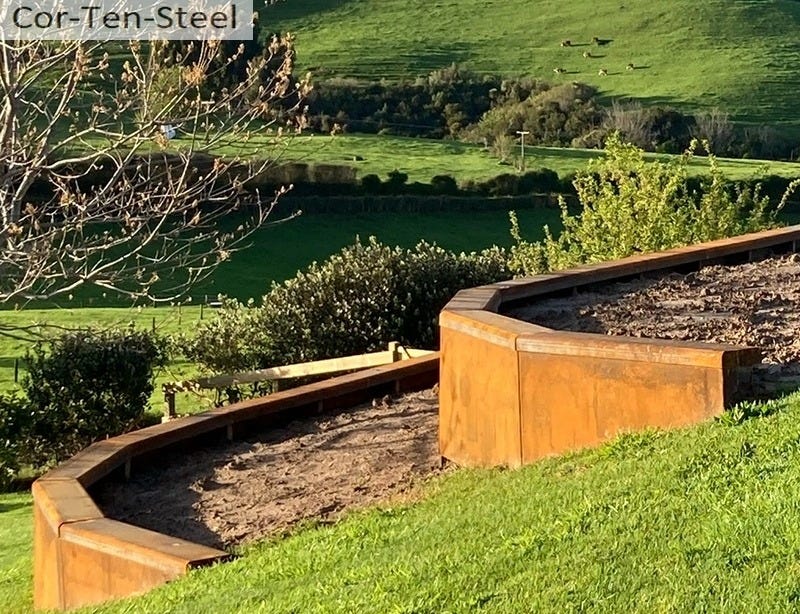
Surrey is home to many beautiful, sloped landscapes, but these gradients can be difficult for planting and soil retention. Traditional timber sleepers are often the go-to choice for terracing, but they have a limited lifespan in our wet winters. They rot, they harbor slugs, and they eventually lean under the pressure of saturated soil. The most common type of sleeper are recycled railway sleepers. Railway sleepers are soaked in creosote, which is a very toxic chemical. For this reason, environmental agencies have discouraged against use of recycled sleepers in residential gardens.

Using Corten steel as siding for terraced planting areas is a game-changer. Steel allows for much thinner profiles than timber or stone, meaning you lose less space to the retaining structure itself. Steel is strong and a thin 3mm or 5mm Corten panel can create a series of striking stepped beds on a hillside. The earthy, metallic tones of the steel provide a perfect backdrop for the blue-grey of Mediterranean plants or the lush green of ferns and woodland species.
Furthermore, as a fencing material, Corten provides a level of privacy and wind protection that is unmatched. Full-height Corten panels can be used as “architectural screens.” When laser-cut with patterns or left as solid, monolithic slabs, they create a sense of enclosure that feels permanent and secure. They don’t warp in the sun, they don’t rattle in the wind, and they provide a stunning contrast to the shifting shadows of nearby trees.

Managing the “Bleed”: Best Practices for Installation
It is important to remember that corten is often sold with no visible patina. During the first few months of the weathering process, the steel will “bleed” some of its oxide. On grass or in soil, this is invisible and harmless. However, if you place Corten directly onto light-colored paving or porous stone, it can leave a permanent orange stain.
To manage this, particularly in landscapes with porcelain or sandstone patios, one should design a buffer zone. This might involve a small strip of decorative river stone or a hidden drainage channel between the steel and the paving. Once the patina has fully stabilized, usually after 12 to 18 months, the bleeding stops, and the material becomes stable. Some suppliers will offer to sell a pre-weathered version that already has a patina, but that will cost extra. I prefer the raw version because you can see it mature as your landscaping establishes itself after planting.
A Sustainable Choice for the Modern Garden
Sustainability is a necessity in modern landscaping. Corten steel is 100% recyclable. Unlike pressure-treated timber, which is infused with chemicals to prevent rot, or plastics that eventually break down into micro-plastics, steel is a natural element that can be repurposed indefinitely.
The longevity of corten also contributes to its sustainability. By choosing a material that does not need to be replaced every few years, you are reducing the carbon footprint of a landscape. Corten is a material that respects the history of the space it occupies, feeling as though it could have been unearthed from the soil itself.
Why Corten Belongs in your Landscape
Any garden material needs to be as resilient as it is beautiful. Corten steel offers a conflation of 2 aesthetics: it is industrial and organic.
Whether it’s the crisp definition of a lawn border or the dramatic steps of a terraced hillside, corten steel provides a solution that celebrates the passage of time rather than fighting it. It isn’t rusty metal, it is a living, breathing component of the garden that promises to stand guard over a landscape for a long time.
The rain will fall, the humidity will rise, and your Corten will only get better because of it.