

The landscape of the Surrey Hills National Landscape is lovely. What is lovely are the sunken lanes, dense ancient woodlands, and sweeping heathlands that dot the hillsides of this area of splendid beauty.

There is something less lovely here, too. For homeowners that live on hillsides or along the edges of commons like Hurtwood or Holmwood, wildfire resilience is becoming a crucial component of modern landscape design. Recent summers have brought prolonged hot, dry spells to the area that are shifting the baseline of fire danger across Southeast England.
Firescaping
Firescaping is a strategic approach to landscape design and maintenance that aims to minimize the risk of wildfires spreading to a home or structure. Rather than completely stripping a property of its natural beauty, it focuses on a few key factors.
One of those factors is the use of fire-smart plants that naturally retain moisture, establishing defensive buffer zones. Another is the practice of pruning vegetation to eliminate vertical fire ladders that allow ground fires to climb into the tree canopy. Essentially, it is the art of designing a landscape that is both aesthetically pleasing and defensive against fire, proving that a garden can be both attractive and disaster-resilient.
For many people, fire prevention in landscaping is achieved by reducing the plants and organic matter. The goal of firescaping is not to clear-cut your property or transform a garden into a barren concrete patio. Instead, it is about using strategic plant selection, smart spatial layout, and precise pruning to dramatically reduce the vulnerability of your home while maintaining, and enhancing, a naturalistic, biodiverse English garden aesthetic.
Heathland and Hillside Risks
To design a fire-smart landscape in Surrey, one must understand how fire behaves in the local environment. Wildfire danger in the UK is dictated by vegetation type and topography. According to historical data tracked by the Forestry Commission, open habitats like lowland heaths account for nearly 80% of the total area burnt in UK wildfires. People often think that wildfires are always in forests. I guess forest fires are more dramatic and make for better content in videos, when in fact open areas are where most of the wildfires happen.

Lowland heathlands are dominated by highly flammable, oily plants such as gorse (Ulex europaeus) and heather (Calluna vulgaris). When a heatwave dries out these plants, they become fuel that ignites easily and carries fire rapidly across horizontal surfaces.
Furthermore, the topography of the Surrey Hills introduces a distinct physical challenge: slope physics. Fire travels significantly faster uphill than it does on flat ground. As a fire burns on an incline, the rising convective heat and radiant energy tilt forward, directly preheating and drying out the vegetation further up the slope before the flames even arrive.
If your home sits atop a hillside or ridge overlooking a wooded valley or heathland common, your landscape requires special buffering to disrupt this upward run.
Fire-Smart Plant Palette
No plant is completely fireproof; under extreme conditions, all organic matter will burn. However, plant flammability varies markedly due to several factors such as moisture retention, leaf structure, and chemical composition.
Flammable Conifers
A common risk in traditional English suburban and rural gardens is a heavy reliance on dense, resinous conifers for screening. Hedges and small trees like Leyland cypress (× Cuprocyparis leylandii) and pine (Pinus ssp.) contain high concentrations of terpenes and resins. These are highly flammable when subject to heat, like oil in a kitchen. They also tend to trap deep pockets of dead, dry needles within their interior framework. This combination creates a perfect fuel package that can ignite explosively from airborne embers.
Embracing Native Deciduous Flora
To help protect against wildfire risk, one should try to substitute high-risk conifers with spacious arrangements of native deciduous trees and moisture-retentive understory plants. Deciduous hardwoods naturally hold significantly more water in their foliage during the peak of summer, making them far more resistant to ignition.
When shopping for plants to use in a naturalistic native garden, it is a good idea to pick out plants with broad, fleshy leaves that lack a strong odor when crushed.

The Fire Ladder
One of the most effective structural interventions used in wildfire management is the elimination of fuel ladders. A fuel ladder is when vegetation allows a simple ground fire (burning through low grass or leaf litter) to climb into tall shrubs, then into understory trees, and finally up into the upper canopy, where it can send embers flying towards the roofs of buildings. This fire ladder turns a manageable surface fire into an intense, destructive inferno, also known as a crown fire.
The Ladder Effect
Without vertical separation, low-level surface fires use mid-level shrubs as a staircase to engulf the forest or garden canopy.
In the Surrey Hills, we can adopt this concept without stripped-back or clinical styling by performing preventive pruning:
Crown Lifting Mature Trees: Prune away the lowest branches of mature canopy trees up to a height of approximately 2 metres from the ground. This breaks the vertical link between the ground plane and the upper foliage. This is also known as “limbing up” a tree.
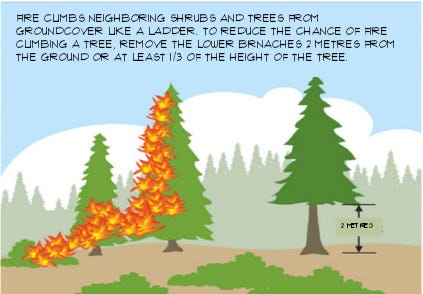
The Two-Thirds Rule for Specimens: For smaller ornamental trees or large structural shrubs, ensure that the lower branches are cleared up to one-third of the plant’s total height.
Strategic Understory Clearing: Avoid planting dense, medium-height shrubs directly underneath the canopy drip line of trees. If you want a natural woodland garden style, use low-growing, moisture-rich herbaceous ground covers beneath your trees instead of structural woody plants.
Horizontal Discontinuity: Rather than planting a continuous, unbroken wall of shrubbery across your property, arrange your plantings in distinct clumps or islands separated by open turf, stone pathways, or succulent groundcover. This layout restricts a fire’s ability to leap horizontally across the garden. This is known as a fire break when vegetation is cleared completely to prevent the spread of a wildfire.
4. Defensible Space Zoning in a Naturalistic Layout
To guide your design layout, divide the landscape surrounding your home into distinct zones. Design hardscaping and low-fuel fire breaks to create an aesthetic and also protective transition between zones.
Zone 1: The Immediate Structure Buffer (0 to 1.5 Metres)
This is the most critical zone for preventing direct flame contact or ember ignition against your home’s external walls.
Maintain a zero-vegetation or low-fuel footprint immediately adjacent to walls, timber cladding, or low windows.
Replace traditional organic wood bark mulches with non-combustible alternatives. Gravel or slate blends seamlessly into an English country aesthetic while ensuring that windblown embers have less chance to create a small fire against the structure. Bare soil and compost are generally not combustible, but a mulch is recommended as it will act to hold moisture in the soil.
Zone 2: The Managed Garden Zone (1.5 to 10 Metres)
This zone covers your main patios, lawns, and ornamental beds that are close to buildings.
Keep herbaceous borders well-hydrated. If you have any no-dig gardening beds, ensure your upper layers are kept moist or topped with a thin layer of sharp sand to prevent dry organic matter from catching stray embers.
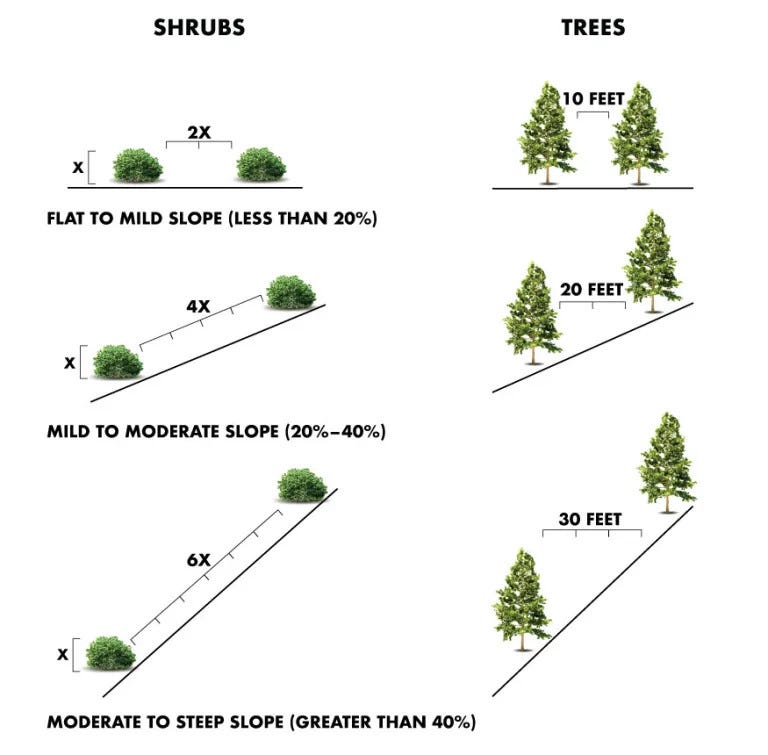
Slopes: If your garden sits on a slope with an incline greater than 20%, expand the horizontal spacing between your plant groups. FYI, a 20% slope is where the ground rises 20 cm for every 1 m in distance. You can measure this in Google Earth if you are not sure what your slope is. Because fire climbs slopes efficiently, a shrub planted on a hillside needs to be spaced further from its uphill neighbor than it would be on a flat lawn.
Zone 3: The Extended Woodland or Boundary Zone (10 Meters+)
This is often where your garden interfaces directly with the wider Surrey landscape. This mainly applies if your property abuts any wild areas. It can also apply if you live next to a poorly maintained service road.
Focus on thinning out dead wood, managing invasive bracken and brambles, and ensuring that native trees or tall shrubs are healthily spaced so their canopies do not form a dense, unbroken jungle. If you live next to an area that is not properly managed, you may need to completely strip your side of the property line. You can hide this barren strip behind hedging or maybe use it for storage built with masonry.
Maintenance for a Fire-Smart Garden
Firescaping is not a one-time project; it is something that should be incorporated into regular garden maintenance.
Late Winter Pruning: Use the dormant winter period to structural-prune your deciduous trees, lift canopies, and cleanly remove any dead or diseased wood before the spring growth flush.
Early Summer Clearing: As spring wildflowers fade and dry out in June and July, cut back the spent stalks and clear out dried ornamental grasses close to structures.
Managing High-Risk Biomass: Avoid piling up dried brushwood or logs near your home or timber outbuildings. Store firewood stacks outside of Zone 1, preferably uphill from any habited dwellings.
Working with Landscape Designers
If you hire a landscape designer to help you plan a firescaped garden, make sure they give you a care guide so that you know how to apply the maintenance plan. The plan described above is broad, and you should have a maintenance plan that details how each plant in your garden should be managed to a similar seasonal pattern. Even if you do not intend to do any gardening, it is a handy resource for anyone you may hire.
Government Resources for Homeowners
Government agencies are steadily adapting their guidance for the wildland-urban interface. Homeowners seeking authoritative, local advice can consult several key organizations:
Surrey Fire and Rescue Service (SFRS): Periodically issues seasonal community safety alerts, farm management briefs, and wildfire prevention tips tailored specifically to the high-risk heathland districts of the county.
The National Fire Chiefs Council (NFCC): Coordinates the UK Wildfire Group, which provides national strategic guidance, real-time fire danger evaluation frameworks, and wildfire prevention toolkits.
The Forestry Commission: Publishes comprehensive research notes on building long-term landscape-scale fire resilience through adaptive forestry and fuel management practices.