

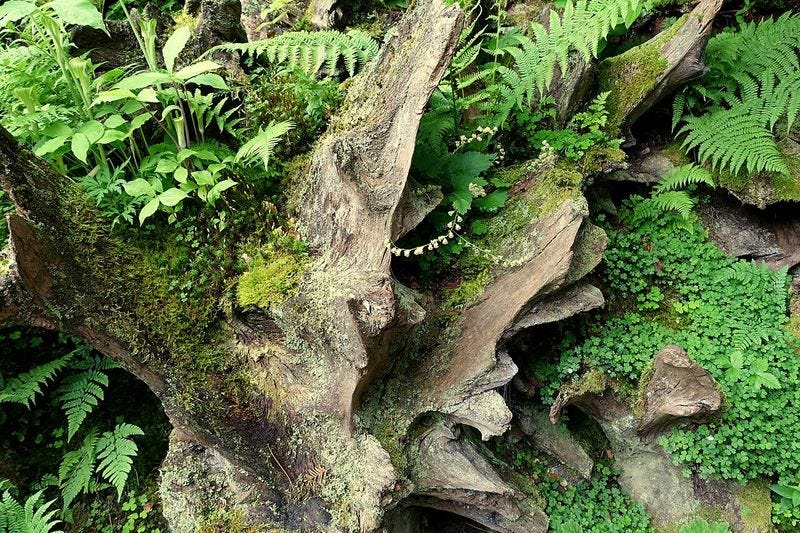
You are likely familiar with traditional garden features; you know that rock gardens provide structure, manicured lawns offer expanse, and flower borders deliver bursts of seasonal colour. Less known about is a garden feature found in the dappled shade of woodland edges. This is one of the most ecologically vibrant features in landscape design: the stumpery.
A stumpery is an intentional arrangement of upturned tree stumps, gnarled roots, weather-worn logs, and timber bark, interplanted with shade-loving flora like ferns, mosses, and woodland bulbs. Stumperies are living sculptures and useful engines for biodiversity. The stumpery embraces the dramatic beauty of natural decay. Stumperies began as an eccentric trend in 19th-century Victorian horticulture and have re-emerged as a vital tool for modern, climate-resilient, and eco-conscious garden design.
A Brief History of Stumperies
The origin of the stumpery is tied to the mid-19th century, when British horticulture experienced an explosion of curiosity driven by plant hunters returning from abroad. In 1856, artist and botanist Edward William Cooke designed the world’s first recorded stumpery at Biddulph Grange in Staffordshire. Working alongside landowner James Bateman, Cooke needed a dramatic way to display a growing collection of newly imported ferns while utilising the clearings left behind by estate expansion. In this stumpery, tree stumps are piled high to form 10-ft walls that edge a garden path to support ferns and other shade-loving plants.
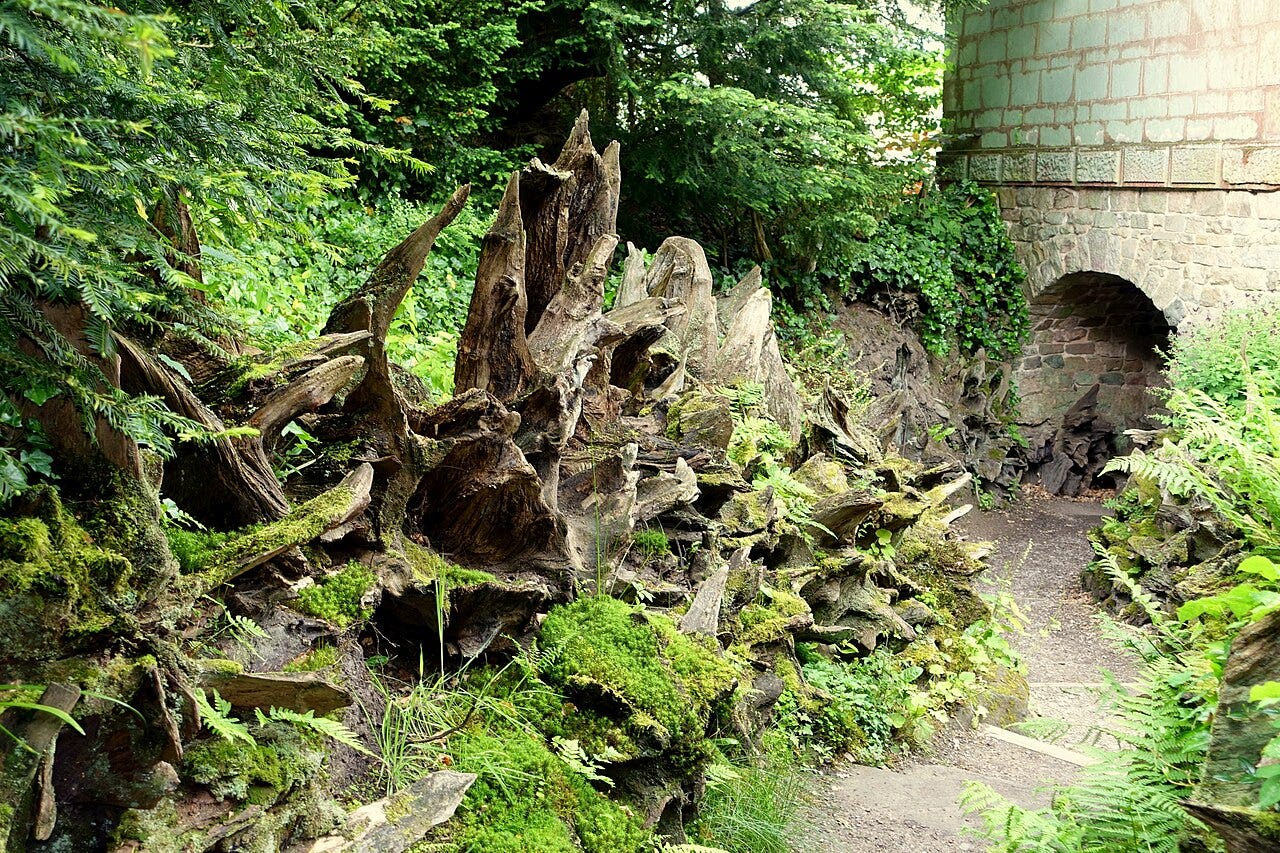
The invention aligned well with two contemporary Victorian obsessions: Pteridomania (Fern Fever) and the Romantic movement’s fascination with Gothic aesthetics, ruins, and wild, untamed nature. Instead of discarding upturned tree roots during land clearing, gardeners stacked them to form cavernous walls, sunken paths, and raised banks that mimicked rocky ravines. The hollows and damp bark provided microclimates for delicate shade plants to flourish.

While stumperies fell out of favour during the early 20th century as gardens favoured manicured borders and open lawns, the feature experienced a high-profile renaissance in the late 1990s. King Charles III (then Prince of Wales) commissioned a massive stumpery at Highgrove House, constructed from sweet chestnut and oak stumps cleared during storms. Designed and built by Isabel and Julian Bannerman in 1996, the stumpery at Highgrove is considered the largest in the UK. Highgrove demonstrated to the modern gardening world that deadwood could be used as an enchanting, atmospheric highlight of a contemporary estate.
Ecological Powerhouse Hiding in Plain Sight
The use of stumperies addresses one of the deficits in modern landscapes: the loss of deadwood habitat. In managed woodlands and residential gardens, fallen trees and dead branches are frequently cleared away for tidiness. However, deadwood is a foundational element of healthy woodland ecosystems.
A decaying stump left to rot naturally is a bustling hub of biological activity:
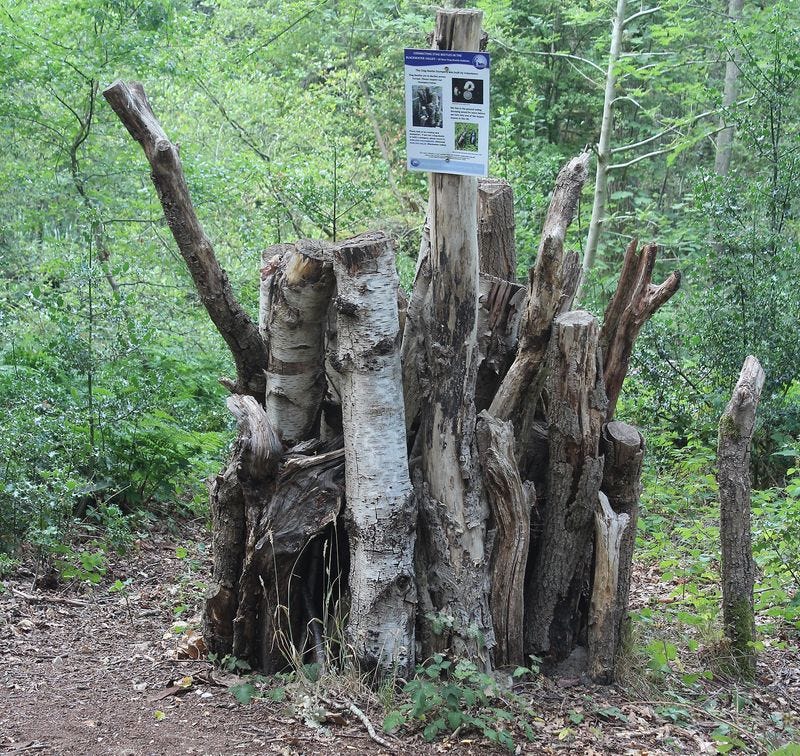
Saproxylic Biodiversity: Hundreds of species of beetles, including the endangered stag beetle (Lucanus cervus), rely directly on decaying wood for their larval development. Some stumperies have been created specifically as ecological devices to help Stag Beetles, like the example in the photo below. Solitary bees, wood-boring insects, and beneficial predators nest within crevices and abandoned insect galleries.

Fungal and Mycelial Networks: As wood decomposes, saprophytic fungi break down lignin and cellulose, converting dense timber into nutrient-rich humus. Fungal fruiting bodies, from delicate bonnet mushrooms to shelf bracket fungi, add layers of autumnal colour and texture.
Moisture Sponges and Carbon Storage: Deadwood acts as a natural sponge, absorbing rainwater during wet periods and slowly releasing moisture into surrounding soil during dry spells. Staining the ground with organic matter that locks carbon into the soil while building a thriving soil food web without synthetic fertilisers.
Wildlife Sanctuaries: The hollows and cavities in Stumperies provide frost-free shelter for overwintering amphibians like toads and newts, as well as hedgehogs, shrews, and cavity-nesting birds.
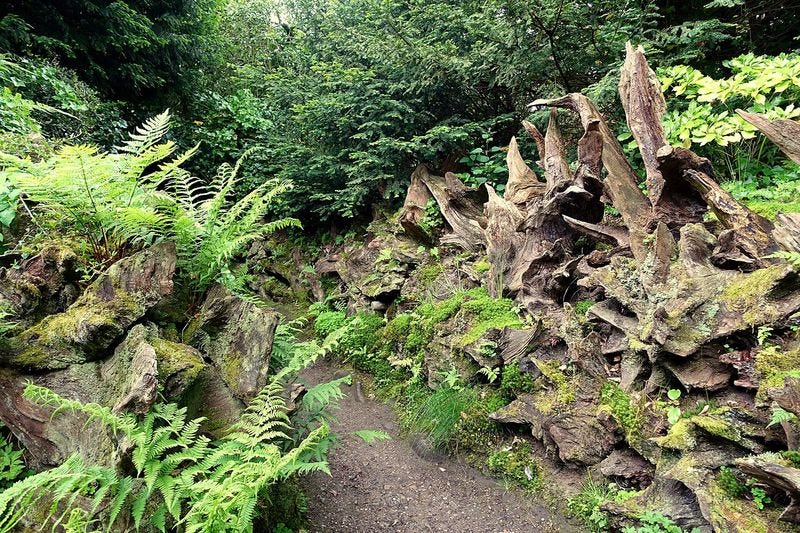
Designing a Stumpery: Scale, Placement, and Timber Selection
Integrating a stumpery into a modern garden requires a balance of natural informality with intentional design structure. Here are some of the key principles to creating your own stumpery:
1. Site Selection
Stumperies thrive in areas where traditional sun-loving plants struggle:
Beneath the canopy of mature deciduous trees.
Along dark, north-facing fences or wall footings.
In naturally damp depressions or low spots in the garden.
As a transitional element between formal garden beds and wild, uncultivated space.
2. Choosing the Right Timber
Not all wood decomposes at the same rate. Choosing a mixture of species ensures structural longevity while encouraging varied ecological colonisation:
Hardwoods (Oak, Sweet Chestnut, Beech, Hornbeam): Oak and sweet chestnut have high tannin content, allowing root structures to retain their sculptural shape for 15 to 25 years.
Softwoods (Pine, Birch, Spruce): Birch and pine decay rapidly, breaking down within 3 to 7 years. They provide fast habitats for fungi and mosses but should be used as secondary filler rather than key anchor stumps.
Yew and Cedar: Highly resinous and rot-resistant, these timbers weather into silver-grey relics over decades.
Look for root plates with jagged, dramatic flares, hollow trunks, and twisted limbs rather than clean-cut log rounds.
3. Spatial Arrangement
Avoid placing stumps in flat, orderly rows. Instead:
Invert and Elevate: Flip root systems upside down or position them on their sides to expose the natural geometry of root branches.
Create Vertical Depth: Stack stumps at varying heights or build up soil mounds behind wood to create elevated planting pockets.
Nestle for Stability: Set stumps 20% to 30% deep into the soil. This prevents tipping, aids moisture transfer between ground and timber, and makes the arrangement feel grounded in the landscape.
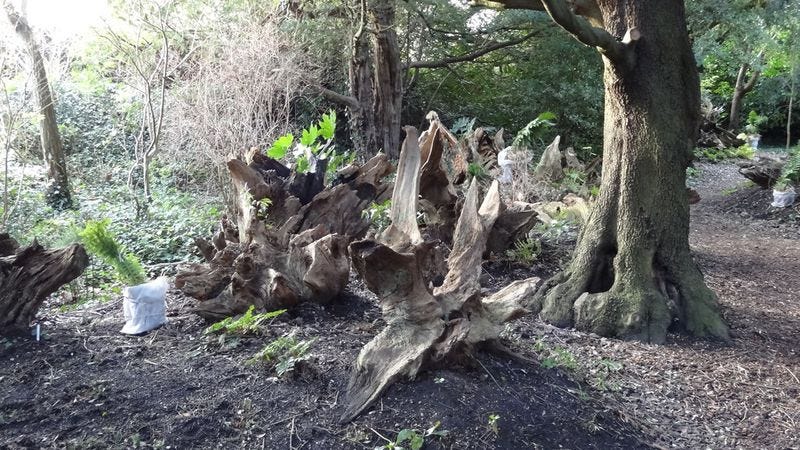
The Plant Palette: Softening the Timber
Plants complete the transition from a pile of timber to an enchanting garden feature. The goal is to weave soft, delicate foliage, varied textures, and subtle woodland colour through the hard, dark surfaces of the wood. Here is a selection of woodland plants that would work well in a stumpery:
Architectural Fern: Soft Shield Fern (Polystichum setiferum). Evergreen, feathery fronds; ideal for nestling into root crowns.
Broad-Leaf Fern: Hart’s Tongue Fern (Asplenium scolopendrium). Glossy, strap-like fronds providing stark architectural contrast.
Deciduous Fern: Autumn Fern (Dryopteris erythrosora). Coppery-red young fronds turn bright green as they grow, adding seasonal interest.

Shade Perennial: Barrenwort (Epimedium × versicolor). Heart-shaped foliage with delicate spring flowers; drought-tolerant ground cover.
Textural Ground Cover: Japanese Forest Grass (Hakonechloa macra). Cascading blades that soften hard timber edges and catch light.
Spring Bulb Snowdrop (Galanthus nivalis). Naturalises in soil pockets between roots; early nectar source.

Woodland Bulb: Ivy-Leaved Cyclamen (Cyclamen hederifolium). Marbled foliage and delicate pink/white blooms in late autumn.

Steps to Construct Your Own Stumpery
Clear and Prepare: Remove invasive weeds from your chosen shade spot. Preserve rich topsoil and leaf mould. Avoid over-tilling the area to protect existing tree roots.
Lay the Anchor Stumps: Place your largest, most dramatic root plates first. Anchor them firmly into shallow excavated depressions. Group stumps in odd numbers (3, 5, or 7) for balanced visual weight.
Build the Matrix: Interlock smaller stumps, bark slabs, and logs around the primary anchors, leaving deep hollows and pockets between them.
Fill Soil Pockets: Pack root crevices and pockets with a rich planting medium composed of equal parts leaf mould, garden compost, and coarse grit.
Insert Planting: Tightly tuck ferns, alpine shade species, and woodland bulbs into the prepared pockets and around the base of the timber. Water thoroughly to settle soil into hidden air gaps.
Apply Leaf Mulch: Spread a generous 2-inch layer of composted bark or leaf mould around the entire structure to lock in soil moisture.
Embracing the Slow Evolution
Unlike formal gardens that require constant pruning, weeding, and deadheading, a stumpery is designed to evolve naturally with minimal human intervention. As seasons pass, the wood softens, lichens colonise the bark, and fungal mycelium weaves through the soil.
By welcoming deadwood back into the garden, the stumpery bridges the gap between historical landscape art and forward-thinking ecological stewardship, turning decaying timber into a living masterpiece.