

There is an old story told among weavers, bricklayers, and traditional artisans about the philosophy of the deliberate mistake. The story goes that whenever a craftsman completes a complex tapestry, a grand oriental rug, or a beautifully patterned brick wall, they intentionally leave one subtle, calculated flaw in the design. If you ask them why they spent weeks chasing a flawless execution only to intentionally drop a stitch or misplace a brick at the very end, they will smile and offer the humble phrase: “I left one part wrong to show only God is perfect.”
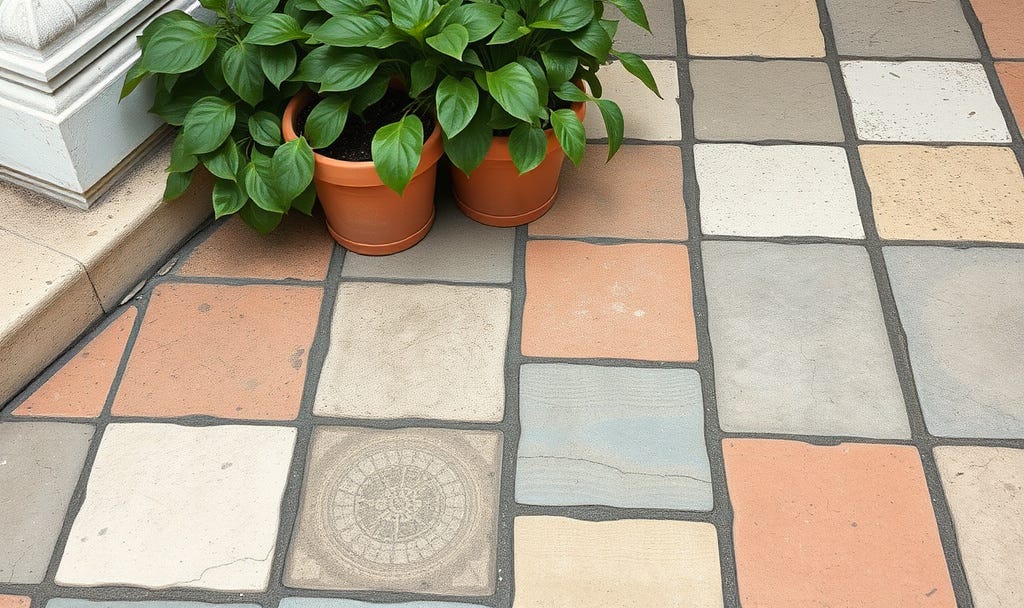
This attitude to embrace imperfection is a good thing. Occasionally, something goes awry in one of my garden design projects. This mistake could be as simple as a straight piece of edging that went in the ground at a funny angle, but still works to hold the soil.
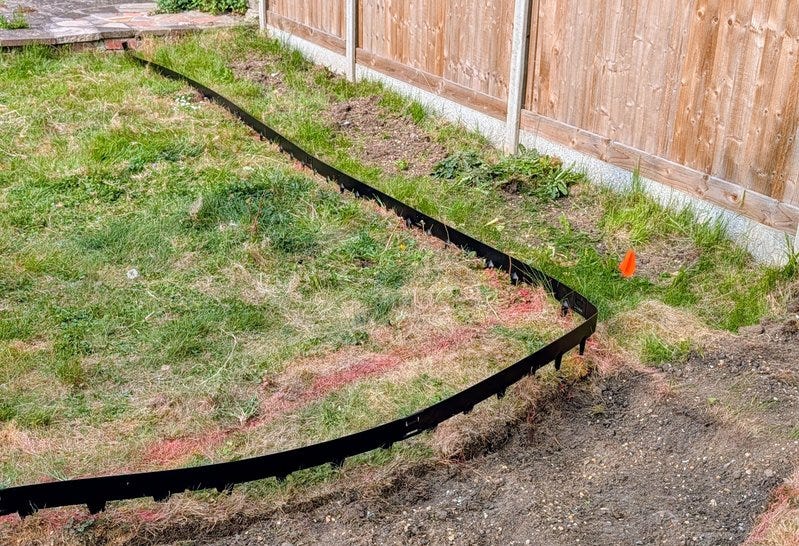
When these little errors result in a slight variance in the layout, and I get annoyed about it, my partner often shrugs and says, “It is what it is”. I often live with the imperfection and work around it as I complete the landscaping. It is what it is. Just like nature, the design will work around imperfections.
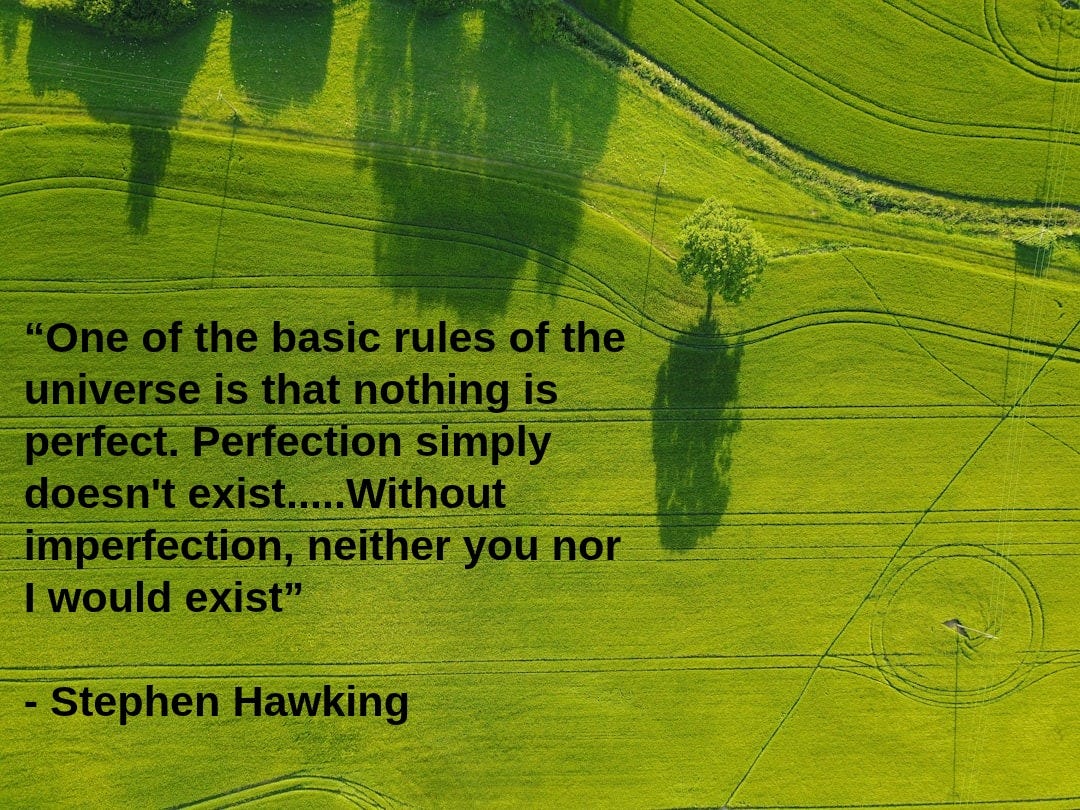
Embrace Imperfection
Perfectionism can create so much anxiety. Why not just accept things as they are? The attitude that we are all flawed and that only God can create the perfect landscape is a philosophy we desperately need to bring back into our modern outdoor spaces. This can be as simple as letting an errant flower grow where it wasn’t supposed to. You can let a plant grow between your pavers, or you might decide to grow more flowers in your concrete patio.

In our hyper-scheduled, pixel-perfect, spreadsheet-driven lives, we have become very obsessed with the straight line. We demand it in our offices, our architecture, and increasingly, in our back gardens because it’s easier to build things in straight lines. But as we look at the minimalist linear landscape designs, we have to ask ourselves: are we building sanctuaries of relaxation, or are we just extending the corporate grid right up to our patio doors?

The Tyranny of the Corporate Grid
Let’s be brutally honest about where I think rigid, laser-straight lines belong. They belong in commercial business parks. They belong in the sleek, sterile courtyards of glass-fronted office towers, where corporate efficiency and predictable order are the guiding principles.

When you look at a modern office park, the landscape is designed to project control. The lawns are sharp rectangles, the hedges are pruned into rigid, green shapes that look like filing cabinets, and the pathways cut through the space with the merciless efficiency of a commuter train. It is orderly, it is clean, and it is profoundly cold.

A landscape designed entirely with straight lines and sharp 90-degree angles does not invite you to linger; it instructs you to move efficiently from Point A to Point B. It is an environment built for productivity, not peace.
The tragedy of modern domestic garden design is that we have started bringing this same office-park mentality home with us.
[The Landscape Conflict]
Office Park Mental Model:  Straight Lines ➔ Rigid Structure ➔ Productivity & Control
The Home Garden Ideal:     Curving Lines  ➔ Organic Flow    ➔ Escape & Relaxation
We spend our working hours staring at rows and columns on computer screens. We navigate city streets laid out on tight grids. We manage our time down to the minute. Our working lives are defined by rigid structure.
So, when you finally log off, step away from the desk, and open your back door, why would you want to look at a garden that looks like an extension of the system you are trying to escape?
A garden dominated by relentless straight lines fails to provide the mental health break we need after a long working day. It keeps your brain in an active, analytical state. Instead of encouraging a sense of wonder, a straight-edged garden acts as a visual reminder of the orderly, high-pressure world outside. It isn’t enough of an escape because it speaks the same spatial language as your working life.
Why Our Brains Crave the Curve
In my previous blog post about curvilinear garden design, we looked at how human psychology is deeply, almost instinctively, drawn to organic shapes. We don’t just prefer curves; our brains are fundamentally wired to find them reassuring.
Serpentine Lines in Garden Design

In nature, you rarely see perfectly straight lines. Curved lines and shapes are commonly found in natural spaces such as meandering rivers, rolling hills, and tree canopies. Incorporating curves into our garden designs creates a more natural and harmonious feel that resonates with our innate appreciation for organic forms.
When we look at a sharp, jagged angle or a stark, unbroken straight line, the primitive parts of our brain register a subtle tension. In nature, sharp angles often represent danger: splintered wood, jagged rocks, or the teeth of a predator. Straight lines represent something unnatural, human-made, and strictly imposed upon the landscape. This is why I let my straight lines turn into curves when I make a mistake in my design installations.
When the human eye tracks a gentle, undulating arc, something entirely different happens.
The Magic of the Serpentine Line
In 1753, the painter and social critic William Hogarth published The Analysis of Beauty, in which he introduced a concept that changed landscape design forever: The Line of Beauty.
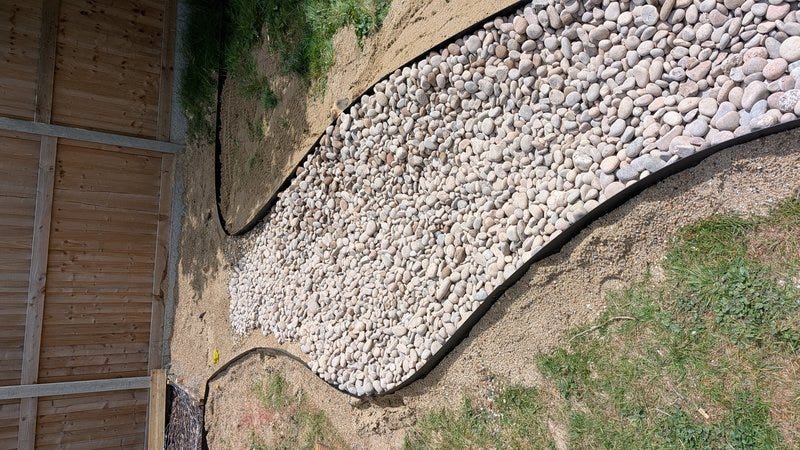
Hogarth argued that a specific type of curve, the S-shaped, serpentine line, possesses a power to excite and engage the viewer. Unlike a straight line, which the eye glides across quickly and predictably, a serpentine line forces the eye to travel along a journey of constant, subtle variation.
It Signifies Liveliness. A straight line is static; a curve implies movement, vitality, and life.
It Creates Intrigue. Because you cannot see what is around a serpentine bend, it awakens our innate sense of curiosity.
It Softens Boundaries. Rigid borders make a space feel enclosed and defined. Curving borders blur those edges, making the transition between the built environment and the natural world feel seamless.

Why Straight Lines Break
As a landscape designer, I look at straight lines through two lenses. First, I see the psychological impact on the homeowner. Secondly, I see the practical reality of building them in an organic, living garden.
There is a great irony in landscape construction. Landscapers often prefer perfectly straight walls, rectangular paving layouts, and sharp, linear borders because they think it looks clean and low-maintenance. In reality, chasing absolute linear perfection in an outdoor environment is an exhausting, uphill battle against physics and time.
Consider what a garden actually is. It is not an interior room with level concrete subfloors and perfectly plumb walls. A garden sits on living, breathing earth.
If you build a 15-metre straight path across a garden, a tiny variance of just 5 millimetres can stand out like a sore thumb. The human eye is incredibly efficient at spotting breaks in linear patterns. You will see the slight dip where the winter rain caused the soil to settle. You will notice the one brick that has shifted slightly out of alignment in your driveway.

By demanding perfect straight lines, you are setting yourself up for aesthetic frustration. You are fighting against the natural way in which the earth moves, breathes, and settles.
Mother Nature’s Beautiful Mistakes
This brings us right back to the philosophy of the deliberate flaw. If we accept that trying to maintain absolute geometric perfection in a garden is an exhausting battle against nature, why don’t we just choose to live with the imperfection instead?
Better yet, let’s reframe those errors entirely. They aren’t failures of design or construction; they are aesthetic reflections of the imperfect world we live in.
Take a look at the most breathtaking natural landscapes on earth. Think of an ancient oak woodland, a windswept coastal cliffside, or a classic chalk stream meandering through the countryside. You won’t see many straight lines there.

The Grand Blueprint
You will never find a laser-levelled edge, a perfect 90-degree angle, or a mathematically straight line in a pristine natural ecosystem. Mother Nature designs entirely in beautiful, functional imperfections.
A tree trunk twists to reach the sun. A river bends because it meets a stubborn pocket of clay. A stone fractures along an irregular fault line. These aren’t errors in nature’s code. They are the very things that give the natural world its soul, its resilience, and its profound beauty.
When we design with straight lines, we often invite minor mistakes. Mistakes like a slight curve where there should be a straight edge, a paving stone that sits a fraction out of line, or a border that isn’t perfectly square. The instinct is often to panic and try to correct it.
But what if we adopted the mindset of the traditional craftsman? What if we looked at that slight imperfection and said to ourselves, “That is where the garden became alive”?
So, the next time you look at your garden and notice a line that isn’t perfectly straight, a stone that sits slightly askew, or a border that has drifted over time, don’t view it as a flaw to be corrected. Smile, take a deep breath of fresh air, and remember the old artisan’s signature.
It is one part wrong, and that is exactly why it feels so completely right.